

What Did We See?
- U.S. Large Cap stocks, or the S&P 500 index, were down about 4.3% in Q1.
- Japan (TOPIX) was the best-performing major equity market, up about 3.6%.
- Europe ex-UK was down about 2.3%; the UK (FTSE All-Share) up about 2.4%, aided by its commodity tilt.
- Emerging Markets were roughly flat at down 0.1%; Asia ex-Japan was down about 1.1%.
- The Bloomberg Commodity Index was the standout performer of the quarter, up 24.4%.
- Brent crude surged 63% in March alone — the largest single-month increase in four decades.
- U.S. Treasuries held their ground, roughly flat for the quarter. Global bonds sold off broadly.
- Value stocks (+1.3%) significantly outperformed growth stocks (-8.4%).
Where Do We Stand?
- The outbreak of war in the Middle East and the closure of the Strait of Hormuz was the defining event of Q1 — and it is far from resolved.
- Markets are resting on a handful of supportive pillars, and more than one is showing cracks.
- Inflation risks have re-emerged, but history suggests oil shocks don’t automatically translate into sustained broad inflation.
- The consumer and labor market are softening quietly beneath the surface.
- Diversified portfolios with commodity and value exposure were rewarded this quarter — a reminder of why broad diversification exists.
The first quarter of 2026 was not a quarter that rewarded complacency. After two consecutive years in which the U.S. market posted outsized gains and defied nearly every bearish forecast, Q1 delivered a more complicated reality: war in the Middle East, an energy shock, a Supreme Court ruling that reshuffled the tariff landscape, and a technology sector that found itself under the microscope just as its spending commitments were reaching new heights. The result was a volatile, uneven quarter in which the usual winners stumbled and an unlikely asset class — commodities — ran the table.
The Strait of Hormuz and the Energy Shock
More than 20% of the world’s oil and gas flows through the Strait of Hormuz. With the conflict effectively closing it, Brent crude — which began the year near $70 per barrel — surged 63% in March alone. At the pump, the national average for regular unleaded climbed to $4.00 per gallon by the end of March, up more than a dollar in a single month. The indirect effects run deeper: energy is an input into virtually everything — transportation, manufacturing, agriculture, distribution.
The obvious fear is that broad inflation follows. History, however, offers some reassurance. Looking back at ten oil price shocks since 1986, the average increase in oil prices was 115%, yet the net change in core PCE inflation from start to finish of those episodes was essentially zero. What happens is that energy prices spike, consumers cut back on discretionary spending, and those offsetting forces keep broad inflation relatively contained. The pain is real, particularly for lower-income households. The inflationary panic, historically, has tended to exceed what the data ultimately delivers.
Commodities Win. Tech Stumbles. Value Makes a Comeback.
The rotation was stark. Technology had a rough quarter as investors questioned whether the hyperscalers could actually demonstrate returns on enormous AI capital expenditures. U.S. software stocks fell 23% from January through late February. Value stocks finished up 1.3% while growth stocks were down 8.4%. Portfolios with commodity exposure, energy, and value orientation were well-positioned — not because anyone predicted war, but because diversification doesn’t require prediction.
The Supporting Pillars Are Wobbling
Markets were being held up by four factors heading into the year: solid Goldilocks economic data, AI enthusiasm, expected Fed rate cuts, and a tolerant attitude toward policy noise. All four came under pressure simultaneously in Q1.
The labor market is softening. December job growth came in at just 50,000, with prior months revised lower. Real disposable income per capita grew by only $233 over the past year — essentially flat. Consumer sentiment, while recently ticking up to 57.3, remains well below the long-run average of 84.7 and at levels historically associated with recession. The Fed held rates steady at its March meeting with just one cut penciled in for the year. And with Kevin Warsh likely to become the next Fed Chair, the political pressure on the central bank is only going to intensify.
Pullbacks Are Normal. The Chart Proves It.
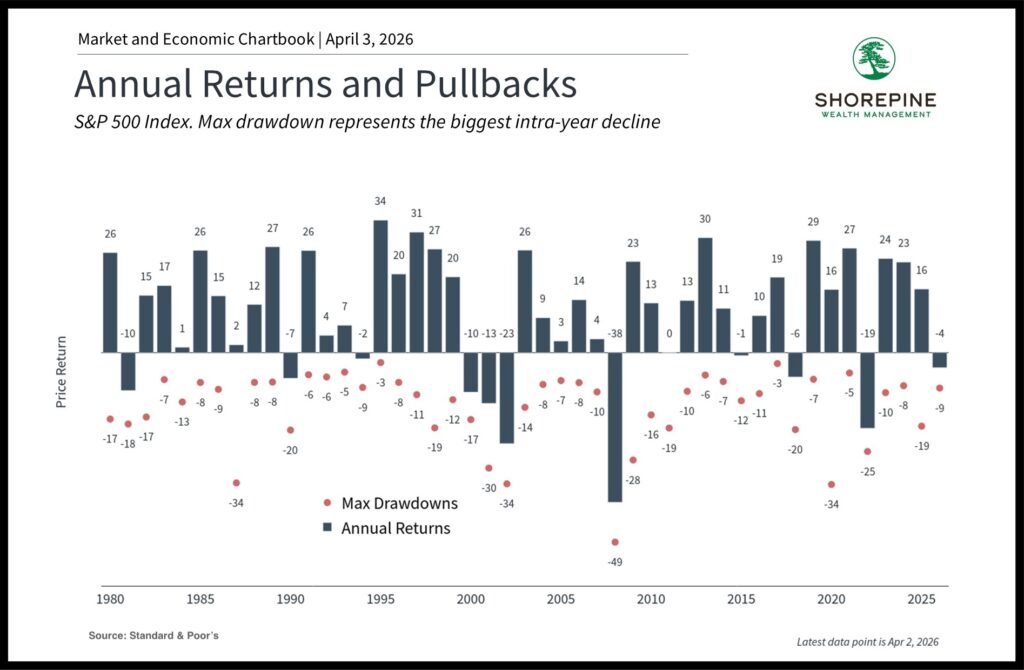
The S&P 500 is down about 4% for the year with an intra-year drawdown near 9% through early April. Uncomfortable, yes. Unprecedented, no. As the chart below shows, significant intra-year declines are entirely normal — even in years that finish positive. In 2025, the index experienced six separate pullbacks of 5% or worse and still delivered 16% for the year. Knowing when to get out is hard. Knowing when to get back in is harder. The market’s best days cluster near its worst, which means stepping aside often means missing the rebound you were waiting for.
In Conclusion
The first quarter of 2026 was a reminder that markets don’t travel in straight lines, and that the supports holding valuations aloft at any given moment are not permanent fixtures. War in the Middle East, an energy shock, a Supreme Court ruling on tariffs, softening labor data, and a technology sector wrestling with its own expectations — that is a lot to process in one quarter.
What it calls for is not dramatic action, but clear thinking. Portfolios built with diversification across asset classes, including commodities, value exposure, and fixed income — were positioned better for this quarter than those concentrated in the trends that dominated 2024 and 2025. That positioning wasn’t a prediction of war; it was the structure that proper planning provides when you don’t know exactly what comes next.
The fog is thick right now. The Middle East situation is fluid. The AI earnings cycle has more chapters to write. The labor market bears close watching. And the Fed faces more political pressure than it has in some time. We are monitoring all of it and will keep you informed as the picture develops.
In the meantime, the plan holds. That’s what it was built for.
If you have any questions or have experienced any changes in your financial situation please do not hesitate to Contact Me
We appreciate you being a part of the Shorepine Wealth Management family!
Investment Products are Not FDIC Insured. No Bank Guarantee. May Lose Value. Investing involves risk. All written content on this website is for information purposes only. Opinions expressed herein are solely those of Shorepine Wealth Management, unless otherwise specifically cited. This is neither a solicitation of offers to buy securities nor an offer to sell securities. Past performance is no guarantee of future results. Material shown here is believed to be from reliable sources however, no representations are made by our firm as to another parties’ accuracy or completeness. All information or ideas provided should be discussed in detail with an advisor, accountant or legal counsel prior to implementation. Shorepine Wealth Management, LLC is a registered investment adviser offering advisory services in the State of California and in other jurisdictions where registered or exempted.